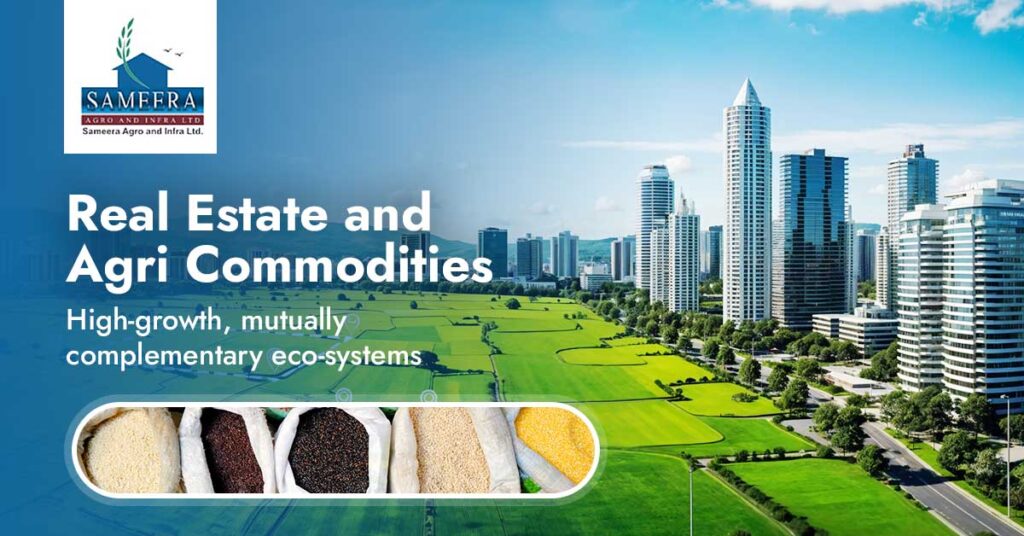
It is conventionally perceived that Real Estate and Agri Commodities are mutually exclusive, that is they have little or nothing to do with one another. Today’s business landscape is turning this traditional perception on its head. With the increasing focus on diversification, sustainability and long term value, Real Estate and Agri Commodities are very connected and can work together in cohesion. Companies like Sameera are working in both sectors leveraging the advantages of each and simultaneously creating synergies for a future-ready ecosystem.
Real Estate: A History of Proven Long Term and Solid Asset Class
For centuries, a plot of land was equivalent to a pot of gold! Landlords from centuries beyond hace held land as a rock solid asset, earned from it, sold it and earned profits. Today is no different. Residential plots, commercial development offer tangible, appreciating assets. This is more so in the context of rapid urbanization, enhanced lifestyles, the rise of the upper middle class and the purchasing power and the consumerism boom.
Urban expansion demands smart cities which in turn demand contemporary amenities and facilities. Land banks are the gold mines and land continues to be the foundational wealth-building asset. Today with the rise of Tier B cities and government initiatives to improve infrastructure, education and amenities in these cities, the demand for Real Estate is only going to escalate in the near future.
Agri Commodities: The Comeback Asset Class
As we move towards a technology-driven world, with bots, AI and machine learning narrowing the gap between technology enabled innovations and the human mind, one growing problem is looming large – food security. It is not only a matter of providing nutrition for all on the planet, but also about how food it sourced.
While the global demand for cereals, food grains, pulses are on the rise, there is increasing focus on sustainable farming methods and organic farming practices to reduce the carbon footprint, conserve water and mitigate the harmful impact of genetically modified food produce and pesticides. Moreover, AI is a game changer introducing faster, better,
sustainable farming in India that demonstrates how technology and human innovation can work for the benefit of the planet at large.
In India, agri reforms, FPOs (Farmer Producer Organizations) and Warehousing Infra are fast improving pointing to a good investment potential in turnkey Agri Commodities business.
So What Is The Connection – Shared Infrastructure Benefits
Land owned for agri purposes can be developed for processing plants, storage unit while at the same time preserved for future real estate development. In addition, location-powered land banks near agri belts can have a dual advantage – for living and logistics.
Strategic acquisition of agri land need not be limited to crop cultivation alone. Such land can serve multiple commercial agendas such as utilizing the land for Agri Processing Plants (since these lands are located in proximity to farms they cut down logistics costs and help maintain freshness of the produce); Storage & warehousing; Over time, areas around productive agri belts tend to urbanize. In this context, agricultural land has immense potential to evolve into prime real estate for further development.
Inversely, locations on the periphery of growing towns and agri production zones are increasingly becoming activity hubs. They have great potential of turning into affordable residential options for workers, warehouse staff and agribusiness professionals. Suburban residential homes are more cost-effective, commute-friendly and proximity of workplace from home offers many advantages.
The other advantage is that these residential areas near agri belts can acts a optimized logistics corridors for farm-to-market supply chains. The result? Reduced logistics costs, quick delivery time, minimizing food produce wastage on account of damage or spoilage.
Locations on the periphery of growing towns and near agri production zones are increasingly becoming hubs of activity. These regions:
A Smart Investment Move – Risk Diversification With a Focus On Steady Growth
Real Estate provides stability as a long term asset class while Agri Commodities offer market-driven liquidity. As two business interests, they mitigate each others risks while working complementary to each other. Moreover, any smart investor will tell us that a multi-sector portfolio is more resilient and a wise move, more so in today’s volatile and uncertain business landscape.
Creating Livelihoods In a Dual Economy
Investments in Agri Commodities and REAL estate both drive employment opportunities such as rural employment, construction labor, farmer income and more.
Real Estate development (both residential and commercial) creates a bandwidth of jobs in construction, architecture, civil engineering, plumbing, electrical etc. Construction is specially useful in creating employment opportunities for Tier 2 and Tier 3 town in India, where there is a volume of both skilled and semi-skilled labour. This uplifts local communities, helps in sustaining lives and provides consistent livelihoods. A growth in Real Estate also means providing demand for local material, contractors and enabling micro-economies within that geographic area.
Agri Commodities business, on its part boosts rural employment and farmer income. Companies like Sameera source directly from local farmers, cutting down unnecessary middlemen resulting in better prices, timely payments and profits for farmers. Investing in on-site processing units and warehouse facilities in rural belts opens up direct employment opportunities for workers skilled in sorting & grading food grains, loading, logistics and overall management.
By working directly with farmers, the Agri Commodities business nurtures agri entrepreneurship as farmers begin to adobe sustainable farming methods, resulting in better yields and making informed decisions about their farming business.
Conclusion
The convergence of Real Estate with Agri Commodities should not be looked at as a happy coincidence, rather a strategic business move leveraging the best of two complementing ecosystems. Companies like Sameera are showing the way of integraign, land, logistics and local sourcing. When company look beyond ROI and work towards a larger vision of creating sustainable impact, diversification and collaborative growth while solving larger issue that challenge the planet, growth gains a fuller and more significant meaning.